[ Analytics ]
How to Drive Traffic to Your Website: The Honest 2026 Playbook
Every realistic channel for getting more website traffic, ranked by effort versus payoff, plus how to tell which ones actually bring people who buy.

On this page
- TL;DR: the traffic channels, ranked by effort vs payoff
- Search (SEO): the channel that compounds
- Content and the topic-cluster approach
- Social and community, where attention already lives
- Paid acquisition without lighting money on fire
- Email and the audience you actually own
- The mistake that wastes every channel: not knowing what worked
- Frequently Asked Questions
Getting traffic is not the hard part. There are a hundred guides telling you to post more, blog more, run ads, and show up on five social platforms at once. Do enough of that and visitors will trickle in. The hard part is getting traffic that does something, and knowing which of your efforts actually caused it. That second part is where most people quietly waste months.
This is the long version: every realistic channel for driving traffic to your website in 2026, free and paid, ranked by how much effort each one costs versus what you get back. We will be honest about the slow channels and the fast ones, and we will spend real time on the mistake that quietly drains all of them, which is not knowing which channel sent you the people who matter.
One thing before we start. There is no single best channel, no growth hack that works for every site. The right mix depends on what you sell, who buys it, and how patient you can afford to be. A local plumber and a global software tool should not chase traffic the same way. So read the rankings below as a map of trade-offs, not a to-do list, and pick the two or three routes that actually fit where you are right now.
TL;DR: the traffic channels, ranked by effort vs payoff
To drive traffic to your website, pick two or three channels that fit your product and your patience, then commit to them long enough to learn. Search rewards you slowly but keeps paying for years. Social and community bring fast attention but fade unless you keep showing up. Paid ads buy instant traffic but stop the moment you stop spending. Email is the one audience you actually own. Below is the rough effort-versus-payoff order, from quickest payback to longest.
The smartest mix usually pairs one fast channel that brings visitors this month with one slow channel that compounds underneath, plus an email list catching everyone in between. But none of it matters until you can tell which channel sent the people who converted, which is the rule at the bottom of the list and the part most people skip.
- Email to people who already know you. Lowest effort, highest return, but only once you have a list. Start collecting addresses on day one.
- Community and niche forums. Low cost, fast feedback, real humans. Great early on, but it does not scale to thousands by itself.
- Paid ads. Instant traffic, instant data, instant bill. Works when you already know what converts, dangerous when you do not.
- Social content. Medium effort, spiky payoff. One post can spike, most do nothing. Compounds slowly as an audience.
- Search (SEO). Highest effort and slowest to start, but it compounds and keeps delivering free traffic for years.
- The rule that beats all of them: measure which channel brings people who actually convert, not just clicks, or you are guessing with a bigger budget.
Search (SEO): the channel that compounds
Search is the channel everyone wants and almost no one is patient enough for. The idea is simple: someone types a question into Google, your page answers it well, and you get a visitor who was already looking for what you offer. That intent is what makes search traffic so valuable. Nobody searches "best invoicing tool for freelancers" by accident.
The catch is time. SEO is slow. An analysis by Ahrefs found that very few newly published pages rank in the top ten within a year, and the pages that do reach the top tend to be older. You can read their breakdown of how long it takes to rank if you want the sobering details. So treat SEO as a channel you plant now and harvest in six to twelve months, not a tap you turn on this week.
What makes it worth the wait is compounding. A blog post that ranks does not get tired. It can pull in qualified visitors every single day for years, with no ongoing ad spend. Ten posts that each bring a handful of visitors a day quietly add up to a meaningful, free, durable stream. That is the opposite of ads, where traffic drops to zero the day your card declines.
Practically: pick keywords with clear intent and realistic difficulty, write the genuinely best answer on the page (not the longest, the best), make sure your site loads fast and works on mobile, and earn a few credible links over time. If you are doing this with a small team and no budget, we wrote a focused guide on SEO for startups that strips it down to what actually moves the needle when you cannot outspend anyone.
One honest warning: do not measure SEO by rankings alone. A page ranking number one for a term nobody buys from is a trophy, not a result. The point is qualified visitors who do something on your site, which is exactly the thread we pick back up in the last section.
Content and the topic-cluster approach
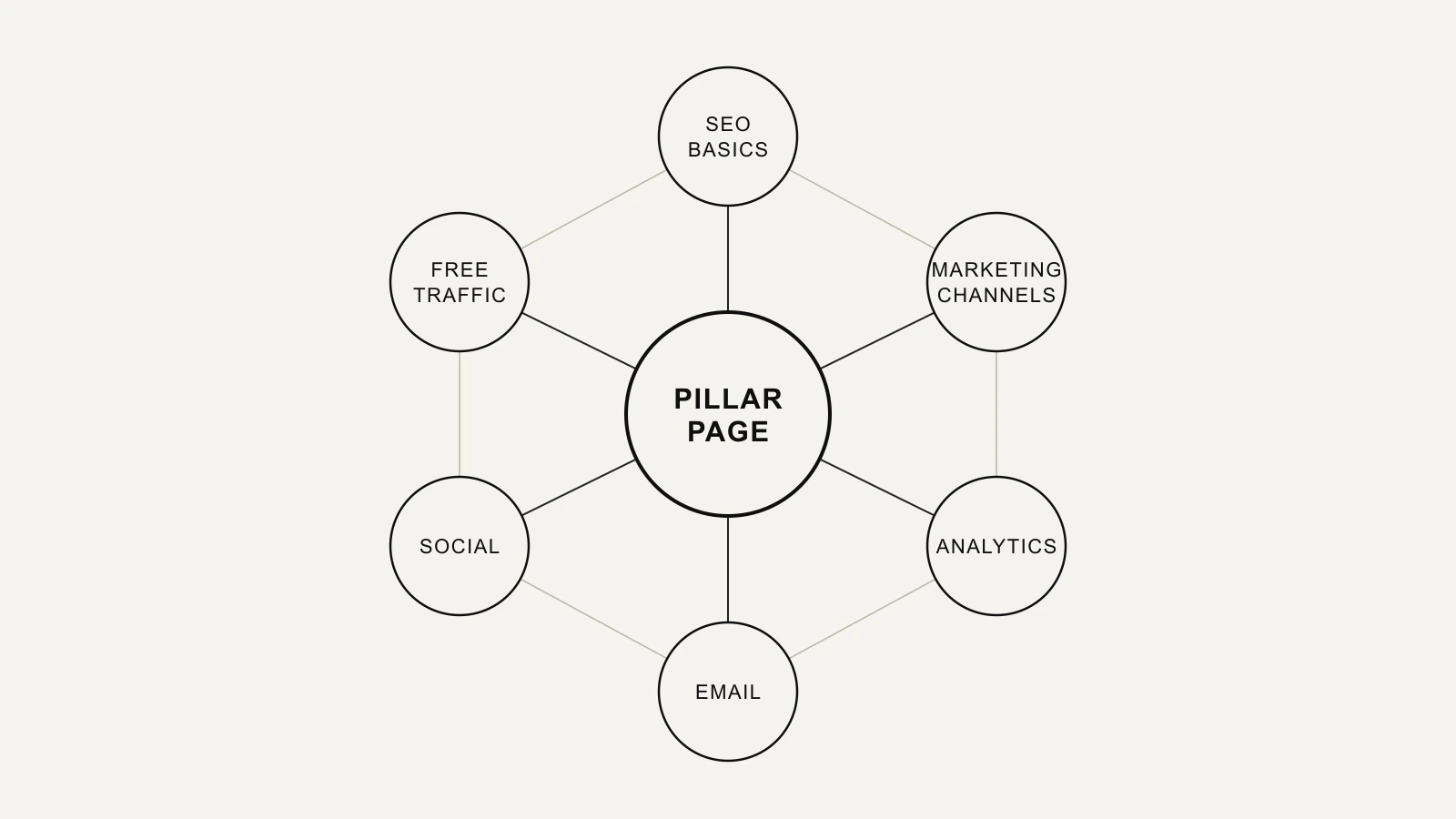
Content is the fuel that makes search work, but writing one-off articles and hoping is a slow way to lose faith. The approach that consistently performs is the topic cluster: pick one broad subject you want to own, write a thorough pillar page on it, then write a set of focused posts around the specific questions inside that subject, all linking back to the pillar and to each other.
Here is why it works. Search engines understand topics, not just keywords. When you have a pillar on, say, "website traffic" plus a dozen supporting posts on free traffic sources, marketing channels, and analytics, you start to look like a site that genuinely knows this subject. The supporting posts catch long-tail searches, the pillar catches the big one, and the internal links pass authority around the cluster so the whole thing rises together.
It also gives readers somewhere to go. A visitor who lands on a post about getting traffic might be a brand new founder, so you point them to getting your first 100 customers. A visitor closer to selling might want how to increase online sales. Each link keeps a real person on your site longer and signals to search engines that your content connects.
A practical way to start a cluster from scratch: write down every real question a potential customer asks before, during, and after buying from you. Sales calls, support tickets, and the "people also ask" boxes in search are goldmines for this. Group those questions into a few themes, and each theme becomes a cluster with a pillar at its center. You end up writing about things people genuinely search for, instead of guessing at keywords in the dark.
The mistake to avoid is publishing for the sake of a posting schedule. Five thin posts that rank for nothing are worse than one post that becomes the definitive answer. Pick subjects where you can say something true and specific that the top results are missing, and you will earn both rankings and trust. Quality is not a vanity standard here, it is the whole mechanism: search engines and readers both reward the page that answers the question best, and nothing else reliably ranks.
Social and community, where attention already lives
Social media gets sold as a traffic firehose. In reality, for most websites it is a slow-build audience channel with the occasional spike. You will post things that vanish without a trace and, every so often, one post that sends a wave of visitors. Both outcomes are normal. The trick is to treat social as a place to build familiarity over months, not a slot machine you expect to pay out today.
Pick the platform where your people actually hang out and go deep on one, rather than spreading thin across five. A developer tool lives or dies on technical communities and the right corners of X. A design product belongs where visuals do well. A local service barely needs social at all and should lean on search and word of mouth. Matching the channel to the audience matters far more than being everywhere.
Community is the underrated cousin of social, and it is often the single best place for a brand new site to find its first real visitors. Niche forums, Slack and Discord groups, subreddits, and industry communities are full of people with the exact problem you solve. Show up as a helpful human, answer questions honestly, and link to your site only when it genuinely helps. You will not get thousands of clicks, but the ones you get are warm, and the feedback is worth more than the traffic.
There is also a craft to the social posts that actually drive clicks. The ones that work tend to deliver something useful on their own (a real lesson, a strong opinion, a genuinely helpful breakdown) and then leave a reason to click through for more. Posts that are pure "check out my website" get ignored, because nobody owes you a click. Give first, and the traffic follows as a side effect rather than a demand.
The honest limit: social and community do not compound the way search does. Stop posting and the attention fades. That is fine if you know it going in and pair these fast channels with a slow one that keeps building underneath. The other reason to be careful here is measurement. Social traffic is famously hard to attribute, since a person might see your post on Monday, search your name on Thursday, and buy from a phone the next week. We will come back to why that matters.
Paid acquisition without lighting money on fire
Paid ads are the fastest way to get traffic and the fastest way to waste a budget. The appeal is obvious: set up a campaign, fund it, and visitors arrive within the hour. No six-month wait, no algorithm to please. The danger is just as obvious. The moment you stop paying, the traffic stops, and if you have not figured out what actually converts, you are simply buying expensive proof that you do not yet know your audience.
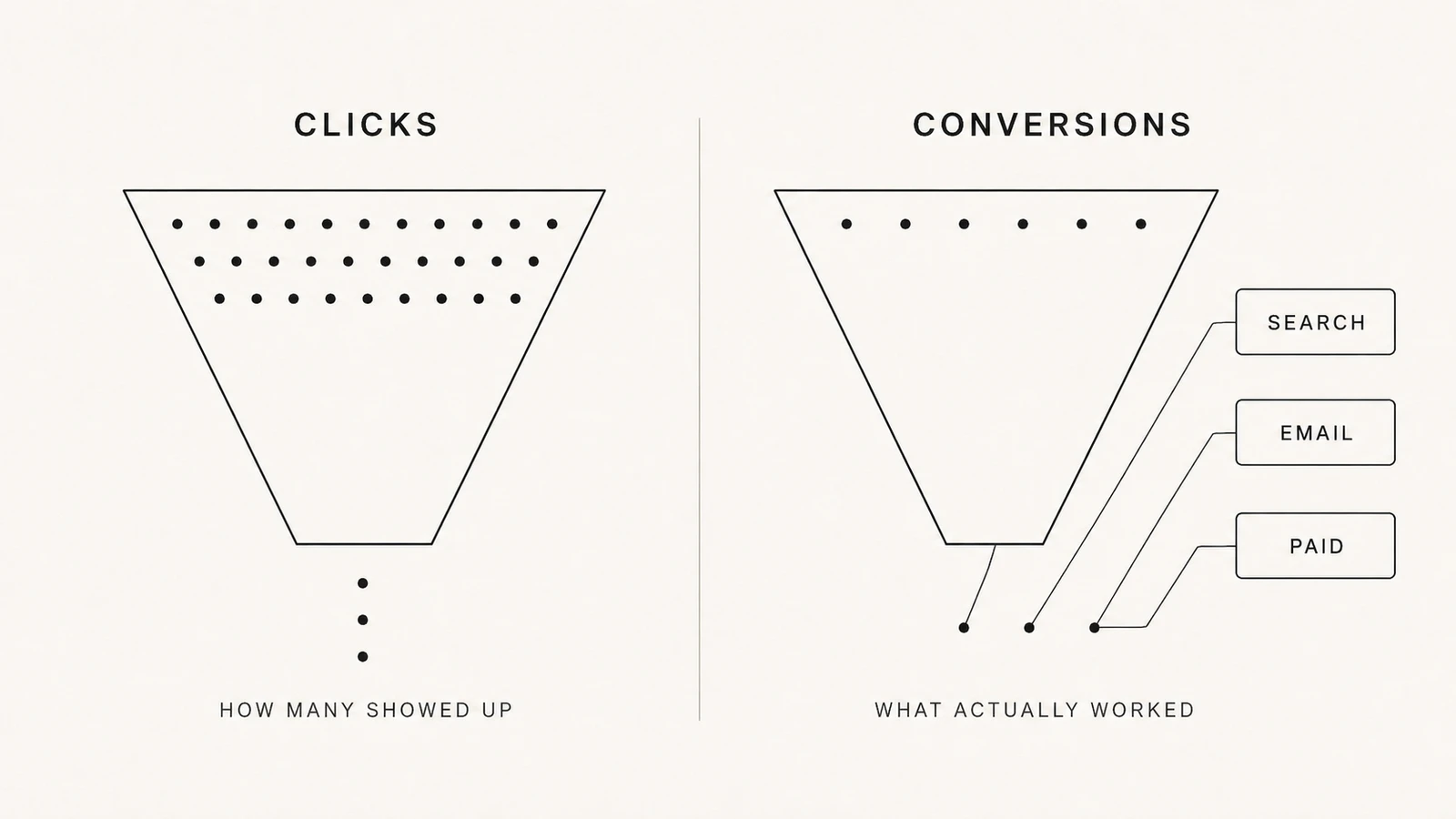
The rule that keeps ads from becoming a money fire: do not scale spend on a page you have not proven converts. Start small. Send paid traffic to one clear landing page with one clear action. Watch not just whether people click, but whether they do the thing you actually care about, signing up, buying, booking. Only pour more money in once a channel shows it brings people who convert, not just people who arrive.
Paid traffic is also a fantastic research tool, even on a tight budget. A week of small ad spend can teach you which message lands and which audience responds far faster than waiting for SEO. Some teams use paid to validate the exact angles they then build free content around. Used that way, ads are not the opposite of organic, they are the scout that goes ahead.
If you do run ads, send the traffic somewhere built for it. Dropping paid clicks on a generic homepage and hoping people find their way is how budgets evaporate. A focused landing page with one message and one action almost always converts better, and it makes the results far easier to read because you have changed only one thing. Match the promise in the ad to the promise on the page, and you remove the most common reason paid visitors bounce.
But the whole thing rests on one assumption: that you can actually see which clicks turned into customers. Spend without that visibility and every campaign report is a guess. That is the failure mode the next section is entirely about.
Email and the audience you actually own
Every channel so far rents your audience from someone else. Google can change its algorithm. A platform can throttle your reach or change its rules overnight. Ad costs can climb. Email is the one channel where the audience is genuinely yours: a list of people who said yes, sitting in a file you control, reachable any time you have something worth sending.
That is why "start collecting emails on day one" is the most repeated advice in this whole playbook. Every other channel should feed your list. A reader who found you through search, a visitor who came from a community post, a click from an ad: the goal is not just that one visit, it is to turn it into an address you can reach again for free. Traffic you can repeat beats traffic you have to keep buying.
It does not take much. A simple offer (a useful checklist, an early-access list, a short course, occasional updates that are actually good) and a clean place to sign up is enough to start. Then send things people are glad to open. A small, engaged list will out-convert a huge cold one every time, and it costs almost nothing to reach.
Email also closes a loop the other channels cannot. When someone joins your list and later buys, you can often trace the whole path, from the first visit to the sale. That kind of clarity, knowing what brought someone in and what they did next, is exactly what most traffic efforts are missing. Which brings us to the mistake that quietly wastes every channel above.
The mistake that wastes every channel: not knowing what worked
Here is the pattern that sinks most traffic efforts. You run SEO, post on social, try a little paid, send some emails. Traffic goes up. Great. But ask which of those channels brought the people who actually signed up or bought, and the honest answer is a shrug. Everything ran at once, the numbers blurred together, and now you are about to budget next quarter on a feeling.
Traffic without attribution is a vanity number. Ten thousand visitors looks fantastic on a chart and tells you nothing about what to do next. If you cannot tie a sign-up or a sale back to the channel that caused it, you cannot confidently double down on the winners or cut the losers. You just keep doing everything, a bit harder, and call a bigger budget a strategy. That is guessing with more zeros.
This is where measurement quietly earns its keep, and it is simpler than it sounds. The principle is just this: connect what people do on your site (sign up, buy, book) back to how they arrived. When you can see which channels bring people who actually convert and not merely click, the fog lifts. You stop pouring money into the channel that looks busy but sells nothing, and you feed the one quietly doing the real work.
You do not need a data team for this, just the discipline to look at outcomes instead of clicks. Tag your campaigns, watch which sources lead to the actions you care about, and pull the thread from there. The general idea is called revenue attribution: instead of stopping at the click, you follow each visitor through to whether they actually bought, so the channel report finally tells you something you can act on. Once you can see it, the whole effort-versus-payoff ranking at the top of this post stops being generic advice and becomes a decision you can make about your own site, with your own numbers.
If you want a calmer way to actually see that path, our writeup on tying traffic back to revenue walks through the idea without the dashboard sprawl.
Frequently Asked Questions
How do I get traffic to a brand new website?
Start where attention already exists instead of waiting for search to kick in. Show up helpfully in the niche communities, forums, and groups your audience already uses, and link to your site only when it genuinely helps. Collect email addresses from day one, and consider a small paid test to learn what message lands. Plant SEO and content now so they pay off in a few months. For the early-stage version of this, see getting your first 100 customers.
What is the best free traffic source?
Search (SEO) is the best free source over the long run because it compounds: a page that ranks can bring qualified visitors for years with no ongoing spend. The catch is that it is slow to start. In the short term, community participation and an email list you build yourself are the most reliable free sources. Most sites do best combining a slow compounding channel (search) with a fast one (community or social).
How do I know which marketing channel actually works?
Stop counting clicks and start tracing conversions. A channel "works" when it brings people who do the thing you care about (sign up, buy, book), not just people who land and leave. Tag your campaigns, and connect what visitors do on your site back to how they arrived. That connection is called revenue attribution, and it is the only way to know which channel deserves more budget and which to cut.
How long until SEO brings traffic?
Plan for months, not weeks. Analysis by Ahrefs on how long it takes to rank found that very few new pages reach the top of search results within a year, and the ones that do tend to be older. Treat SEO as a six-to-twelve-month investment that then keeps paying, and lean on faster channels like community, email, and paid for traffic in the meantime.