[ Tutorials ]
How to Increase Online Sales: 12 Tactics That Actually Work
Most sales advice is a pile of tactics with no way to know which to try first. Here are twelve that work, ordered so you fix your biggest leak before you touch anything else.

On this page
- TL;DR: find the leak, then pick the tactic
- Start with the funnel, not the homepage
- Make your product pages earn the sale
- Get pricing and offers right
- Build trust where the doubt shows up
- Fix checkout, where money quietly disappears
- Turn one purchase into many
- Bring traffic that actually buys
- Do not let a slow store cap all of it
- Frequently Asked Questions
Most advice on how to increase online sales is a long list of tactics with no way to know which one to try first. So you redesign the homepage, run another discount, or rewrite a product description, and nothing much moves, because the thing actually costing you sales was somewhere else entirely.
This guide is twelve tactics that genuinely work, but the order matters as much as the list. The fastest win is almost never a new idea bolted on top. It is finding the one leak that is quietly losing you the most money and fixing that first. So we start there, then walk the whole journey from product page to checkout to the repeat purchase.
TL;DR: find the leak, then pick the tactic
If you remember nothing else, remember this: more sales rarely come from doing more things. They come from finding the single biggest drop-off between a visitor arriving and a visitor buying, and fixing that one step. Every tactic below is worth more once you know where your money is actually leaking.
- Map the funnel first. Find the biggest drop between landing and purchase, and fix that step before anything else.
- Lead product pages with the outcome, not a spec sheet: what the buyer gets, in plain words.
- Show, do not just tell: real photos, real detail, and the answers to the obvious objections.
- Put proof next to the buy button, where the doubt actually shows up.
- Make the price feel like value, with clear anchoring and offers a shopper grasps in seconds.
- Cut the choices that stall a decision instead of helping it.
- Earn trust on sight: real reviews and guarantees, never badge spam.
- Show the full price early. Surprise costs at checkout are the number one reason carts get abandoned.
- Let people buy as a guest. Forced account creation sends a chunk of ready buyers away.
- Recover the carts you already lost with a simple email and a few on-site nudges.
- Bring traffic that buys, and measure which channels produce sales, not just clicks.
- Keep the store fast, because every extra second of load time quietly shaves your conversion rate.
Start with the funnel, not the homepage
Here is the mistake that wastes more time than any other: you feel like the homepage is the problem, so you spend a month redesigning it, and sales barely move. The homepage was never where buyers were leaving. You just could not see where they actually were.
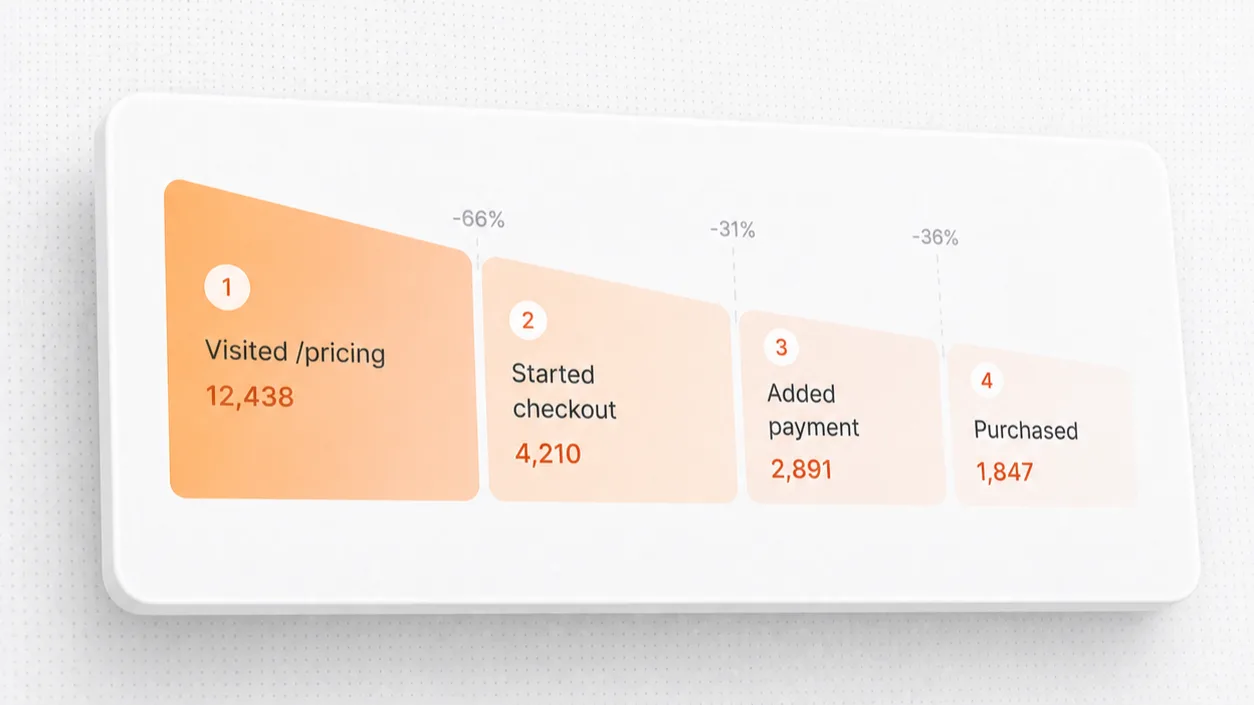
Think of your store as a journey with a few clear steps. Someone lands, looks at a product, adds it to the cart, starts checkout, and pays. At every step, some people drop off. That is normal. What matters is finding the step where you lose far more people than you should, because that single leak is almost always where the fastest, cheapest win is hiding.
This is the whole reason to look at your store as a conversion funnel instead of a pile of pages. Map the path from landing to purchase, see the percentage that survives each step, and the biggest drop points straight at what to fix first. The answer is regularly somewhere you would not have guessed: not the homepage you were about to redesign, but a confusing cart, a slow product page, or a checkout that asks for too much.
You do not need a heavy setup for this. You need to see, for your own store, where the journey breaks. Once you can watch the path from first visit to paid order, the priority stops being a matter of opinion. The largest drop is the work. For an ecommerce store specifically, Zenovay's funnels and the wider ecommerce analytics view are built to make that leak obvious, so you spend your effort on the step that is actually costing you sales.
Make your product pages earn the sale
Once you know where people drop, the product page is usually one of the first places worth tightening, because it is where intent either turns into a decision or quietly fizzles out. A surprising number of product pages describe the product and forget to sell the outcome.
Lead with what the buyer actually gets. People do not buy a 'merino wool blend, 18.5 micron'. They buy 'warm enough for winter, light enough you forget you are wearing it'. State the benefit first, in plain words, then back it with the specifics for the shoppers who want them. Both buyers exist, and the order matters: outcome first, detail underneath.
Then remove doubt before it forms. Use real photos from several angles, show scale, and answer the obvious objections right on the page: sizing, materials, delivery time, returns. Every question a shopper has to leave the page to answer is a chance for them to not come back. If you sell something visual, this is also where honest proof earns its place, which is the next tactic.
- Outcome first, specs second: say what changes for the buyer, then list the details underneath.
- Real, generous photos: several angles, true scale, and the details that matter in person.
- Answer objections on the page: sizing, shipping, and returns, so nobody has to leave to check.
- One clear action: an obvious add-to-cart, not buried under tabs and competing buttons.
Get pricing and offers right
Price is not just a number, it is a story about value, and the way you present it changes how that story reads. The same price can feel expensive or fair depending on what you put next to it.
Give the shopper an anchor. Showing your standard option beside a premium one makes the standard look reasonable. Breaking a larger purchase into its per-month or per-use cost makes it feel smaller. None of this is a trick, it is just helping people judge value with a reference point instead of a vacuum.
Keep offers simple enough to grasp in one read. 'Buy two, get free shipping' converts because anyone gets it instantly. A four-tier conditional discount that needs a paragraph to explain mostly creates hesitation. And be careful with constant discounting: train shoppers to wait for a sale and you teach them your real price is the sale price.
- Anchor the price: show a reference point so value has something to sit against.
- Break big numbers down: per month or per use feels smaller than one large figure.
- Keep offers one-read simple: if it needs explaining, it costs more than it makes.
- Do not train discount addicts: constant sales reset what people believe is fair.
Build trust where the doubt shows up
People buy from people, and online they buy from stores that feel like they will not let them down. Trust is what closes the gap between 'this looks good' and 'I will hand over my card'.
The strongest trust signal is real proof placed exactly where doubt appears: a genuine review beside the buy button, a clear returns promise near the price, a real customer photo instead of a stock model. Specific beats generic every time. A single concrete review that mentions the thing a shopper is worried about does more than a wall of five-star averages that a careful buyer discounts on sight.
Back it with the boring, reassuring basics: a visible returns policy, recognizable payment options, real contact details, and a guarantee if you can stand behind one. If you are a newer store without a pile of reviews yet, lean on what is true. Transparency, a founder's note, and an honest guarantee build trust too, and you can offer them on day one.
- Specific proof beats generic: one real, relevant review outsells a row of stars.
- Proof near the decision: put it beside the price and the buy button, where doubt lives.
- Reassure on the basics: returns, payment options, and contact details, all easy to find.
- A guarantee you mean: reducing the buyer's risk is one of the cheapest ways to lift sales.
Fix checkout, where money quietly disappears
If there is one place to look the moment you can see your funnel, it is checkout. This is where buyers who already decided to pay change their minds, and the scale of it is genuinely startling. Across 50 separate studies, the average documented cart abandonment rate is about 70 percent. Roughly seven in ten people who add to cart leave without buying.
The encouraging part is that most of that is fixable, because it is not about price or intent, it is about friction. The single most common reason people abandon a checkout is unexpected extra costs: shipping, taxes, and fees that only appear at the final step. Baymard's research puts that at the top of the list, well ahead of everything else, with forced account creation the next big offender.
So show the full price as early as you can. If shipping is the sticking point, a clear free-shipping threshold ('free over $50') often lifts both conversion and average order value at once. Let people check out as a guest instead of forcing an account, ask only for the fields you truly need, and keep the steps few and obvious. Every extra field and every surprise is an exit.
When you want to know exactly which step loses people, watching real checkouts is the fastest way to find out. A conversion funnel shows you the step where buyers drop, and a session replay of a few abandoned checkouts usually reveals the culprit in minutes: one confusing field, one surprise cost, one button nobody can find.
- Show the full price early: surprise costs at the end are the number one cause of abandonment.
- Offer free-shipping thresholds: a clear 'free over X' lifts conversion and order value together.
- Allow guest checkout: never force an account on someone who is ready to pay.
- Cut fields and steps: ask only for what the order genuinely needs, nothing more.
Turn one purchase into many
Acquiring a new customer is the expensive way to grow. The shopper who already bought from you, already trusts you, and already has their details saved is the cheapest sale you will ever make, and most stores barely pursue it.
Start with the carts you already lost. A simple, friendly reminder email to someone who abandoned a cart recovers sales you had otherwise written off, because that person wanted the item minutes ago. Pair it with on-site nudges and the occasional well-timed offer, and you are recovering revenue that was already in the building.
Then build the relationship past the first order. A short welcome sequence, a nudge when it is time to reorder, and genuinely useful email (not just discounts) turn a one-time buyer into a repeat one. Owned channels like email cost you nothing per send and are not at the mercy of an ad auction, which makes them the most durable sales channel you have.
- Recover abandoned carts: one timely reminder email wins back sales you had written off.
- Welcome new buyers: a short sequence turns a first order into a relationship.
- Prompt the reorder: remind people when it is time to buy again, before they drift.
- Own your audience: email and SMS are not rented from an ad platform, so they keep working.
Bring traffic that actually buys
Everything above lifts the sales you get from the visitors you already have, which is exactly why it comes first. Once the store converts well, more of the right traffic turns directly into more revenue. The trap is chasing traffic for its own sake.
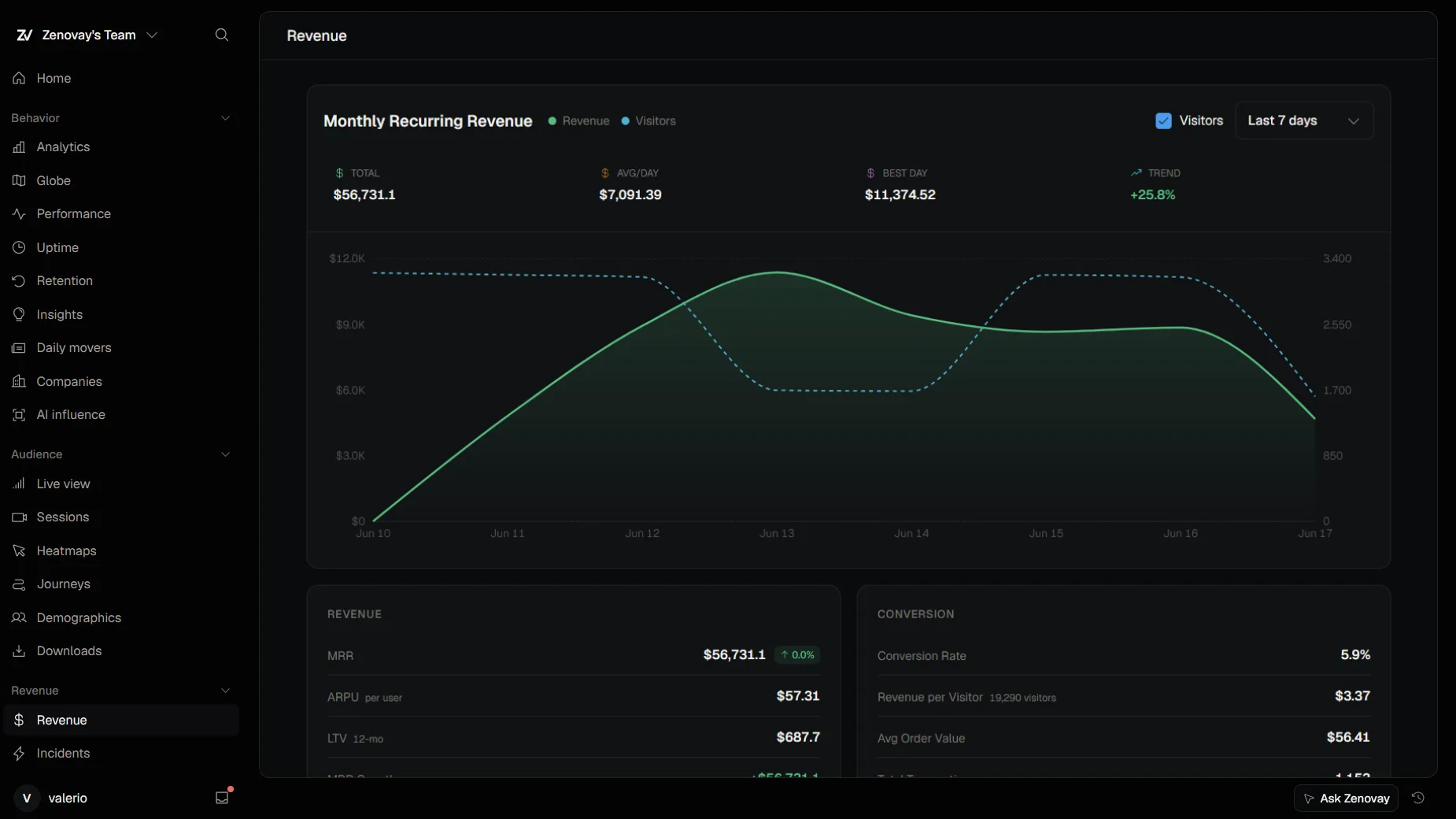
Not all traffic is equal. A thousand visitors from a channel that never buys is worth less than a hundred from one that does. The only way to tell the difference is to tie sales, not clicks, back to where the visitor came from. When you can see which channels produce actual paying customers, you stop guessing and start putting money where it already works.
This is where channel measurement earns its keep. Connecting revenue back to its source tells you that, say, your newsletter and one niche community quietly drive most of your sales, while the busy social channel you pour hours into brings browsers who never buy. That is the difference between scaling a channel and feeding a leak. If marketing is where you are focused next, the marketing analytics view is built around exactly this question.
- Measure sales, not clicks: judge a channel by the paying customers it brings, not its traffic.
- Double down on what converts: put budget and time into the channels that already produce revenue.
- Cut the polite time-wasters: a busy channel that never sells is a cost, not a win.
- Match traffic to intent: people closer to buying are worth more than raw volume.
Do not let a slow store cap all of it
One last thing can quietly cap every tactic above: speed. A store that loads slowly loses buyers before they ever see your improved product page, and the effect is bigger than most people assume. Portent's analysis of millions of page views found that conversion rates drop by an average of about 4.4 percent for every additional second of load time in those crucial first seconds.
On the phones where most shopping now happens, a heavy page is felt immediately. Compress your images, cut the third-party scripts you do not need, and treat your store's speed as part of the buying experience, because it is. A fast, focused page is not a nice-to-have, it is the floor everything else stands on.
Put all of this together and the pattern is simple. The stores that sell more are not the ones running the most tactics. They are the ones who found their biggest leak, fixed it, then moved to the next one, watching what each change actually did. Start with the funnel, fix the step that is bleeding, and work down the list from there.
- Shipping blind: running a store with no view of where buyers drop, so nothing improves.
- Optimizing the wrong page: polishing what felt important instead of where the data points.
- Surprise costs at checkout: the most common, most fixable lost sale on this list.
- A slow first impression: speed is part of conversion, not a separate engineering chore.
Frequently Asked Questions
How can I increase online sales fast?
The fastest gains almost never come from a new idea, they come from fixing your biggest existing leak. Map your store as a funnel from landing to purchase, find the step with the steepest drop, and fix that one thing first. It is usually checkout friction or a confusing product page, and it is usually cheaper and faster to fix than launching anything new.
What is a good ecommerce conversion rate?
It varies so much by industry, price point, and traffic source that any single benchmark is close to useless. A store selling impulse-buy accessories and one selling expensive furniture will never convert at the same rate. Rather than chasing someone else's number, measure your own conversion rate and focus on beating last month. The only trend that matters is yours going up.
Why are people not buying from my store?
Usually for one of a few reasons you can find quickly: they hit an unexpected cost at checkout, the page did not answer an obvious question, the store felt untrustworthy, or it was simply too slow. Watching a conversion funnel and a handful of real session replays tends to surface the actual reason far faster than guessing.
What should I fix first to sell more?
Fix the single biggest drop-off in your funnel. For most stores that is checkout, where the average abandonment rate sits around 70 percent and the leading cause is surprise costs appearing at the final step. Show the full price early, allow guest checkout, and remove every field you do not truly need, then move on to the next biggest leak.